
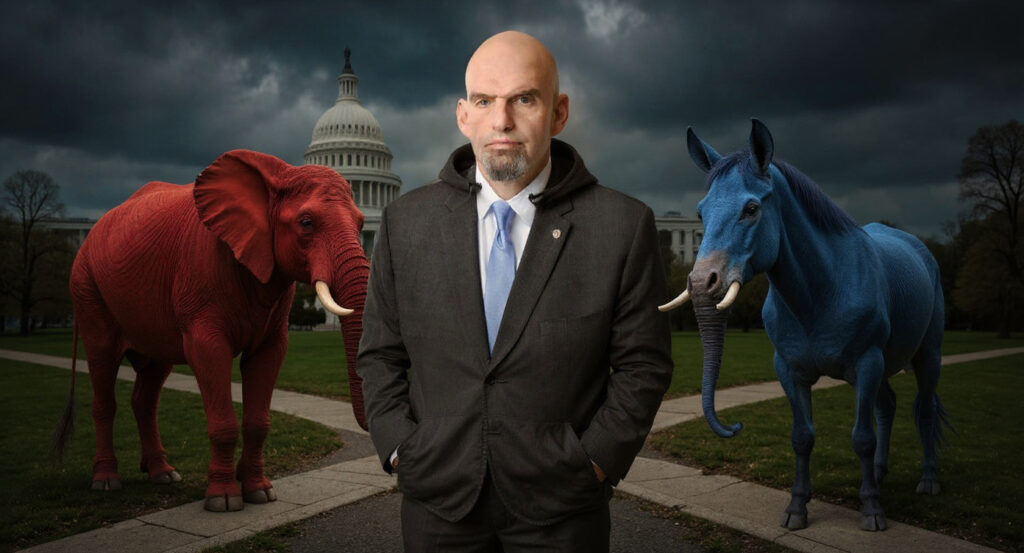
President Trump just sent Sean Hannity — yes, that Sean Hannity — to deliver a personal message to Senator John Fetterman of Pennsylvania: come join the Republican Party, and we’ll back you with “more money than he ever dreamed of.” The six-foot-eight guy in the hoodie who Democrats paraded around as their blue-collar champion is now being actively recruited by the other team.
Democrats spent two years telling us Fetterman was the future of the party. Turns out, the future of the party wants nothing to do with the party. Whoops.
Here’s what’s actually happening. Fetterman has been quietly torching every progressive sacred cow for months now. He’s a strong Israel supporter — which, in today’s Democratic Party, basically makes you a war criminal at the Thanksgiving table. He backs Trump’s approach on Iran. He’s been voting to confirm Trump’s nominees. He just cast the *deciding vote* to advance Markwayne Mullin’s DHS nomination. And he’s doing regular hits on Fox News where he openly trashes progressive Democrats.
At some point, you have to ask: what exactly makes this guy a Democrat anymore? His voter registration card? His hoodie?
The recruitment effort isn’t some back-channel rumor, either. Trump personally tapped Hannity to make the pitch. GOP Senators Katie Britt from Alabama and Dave McCormick — Fetterman’s fellow Pennsylvanian — are both reportedly working the relationship. The full-court press is on, and it’s not subtle.
Trump’s message, relayed through Hannity, was pure Trump: “He’s going to run as a Republican, he’s going to have our full support, more money than he ever dreamed of, and he’s going to win big.” That’s not an invitation. That’s a job offer with a signing bonus.
Now, Fetterman says he’s still a Democrat. He did an NBC interview last month where he reaffirmed his party affiliation. But — and this is the part that has Chuck Schumer reaching for the Tums — sources say he hasn’t completely shut the door on going independent.
Independent. As in, “I’m not technically leaving you, I’m just moving out and taking the dog.”
Think about what that would mean for Senate math. Democrats are already clinging to relevance in the upper chamber like a cat on a screen door. Losing Fetterman — even to independent status — would be a political earthquake. And he doesn’t face re-election until 2028, which means he’s got two full years to make this decision with zero electoral pressure.
Two years of voting with Republicans on key issues. Two years of Fox News appearances. Two years of watching his own party call him a traitor while the GOP rolls out the red carpet.
The beautiful irony here is that Democrats created this situation themselves. They pushed their party so far left that a senator from *Pennsylvania* — not San Francisco, not Brooklyn, PENNSYLVANIA — can’t find a home in it anymore. When your party platform makes a guy who had a stroke on the campaign trail look like the most reasonable person in the room, you’ve got a branding problem.
Fetterman didn’t move right. The Democratic Party moved so far left that standing still made him a Republican.
Remember, this is the same guy who showed up to the Senate in gym shorts and a hoodie. He endorsed every progressive policy in the book during his 2022 campaign. He was their guy. Their champion of the working class.
And now Trump is literally sending Sean Hannity to go pick him up like a kid getting recruited to transfer schools. “Hey buddy, we’ve got better facilities, a nicer locker room, and we’ll actually let you play.”
The funniest part? Democrats can’t even be mad about it in public. They have to pretend everything is fine. “John is a valued member of our caucus” — that’s the official line. Meanwhile, behind closed doors, they’re probably trying to figure out which progressive Instagram influencer they can run in Pennsylvania in 2028 to replace him.
(Spoiler: they’ll pick someone who uses “Latinx” unironically, and they’ll lose by 15 points.)
Whether Fetterman actually flips remains to be seen. But the fact that we’re even having this conversation tells you everything you need to know about where the Democratic Party is right now. They’re losing a senator from a swing state — not because the GOP outspent them or outmaneuvered them, but because their own party became too insane for a guy in a hoodie to tolerate.
We are living in the greatest political realignment of our lifetime, folks. And all we have to do is sit back, crack open a cold one, and watch the Democrats implode from the inside out.